Thursday, 9 November 2017

Strange Birds of the Peruvian Amazon, Writing Mama Amazonica


After the miracle of seeing a jaguar in the wild, comes the miracle of seeing the jaguar-of-the-skies, or harpy eagle. We saw this juvenile on our first trip in June 2016, and a chick in the nest on our second trip in December of that year. We also caught a glimpse of the mama! She is larger than the male, with a 2 metre wingspan, and she crashed through the canopy in a flash of ivory and black, like a giant Holy Ghost. She is the most powerful eagle in the world, with harpy talons. She was a visitation, a Mama Amazonica, and I tried to write about her in my seventh collection Mama Amazonica (Bloodaxe, 2017), in a poem that also features that armadillo the juvenile eagle is clutching in his talons as he learns to hunt. The juvenile gawped at us for at least half an hour, and didn't quite seem to know what to do with his catch, you can just spot the armadillo tail below him. On our way down over the tangle of hillside roots, we saw the hole the armadillo once lived in.


 This is a greater Ani. They make a strange coughing or croaking sound  and cluster at oxbow edges and forest margins.


The most haunting song in the Amazon basin is surely from the pale-winged trumpeter just before dawn. The first time I heard it I thought that maybe it was a generator coming on, though Tambopata Research Center doesn't use generators but solar panels for energy. I thought of the wind playing overhead cables like a harp. And I thought of aliens – surely they had landed in the forest depths? It was a vibrato hum that went right through me and made the roof of my mouth tingle. It was almost four am, two hours before equatorial dawn, and the male howler monkeys had not yet started the first rumbles of their thunderous roars. The titi monkeys were still asleep and had not yet uttered their quarrelsome screaming barks. As the trumpeters faded, bats crashed into the network of strings overhead, a mesh designed to stop roof-nesting tarantulas from dropping on guests in their bed, or at least onto our mosquito veils which swathed the beds. My room was a cubicle in a traditional Ese-Eja wooden long house made from palm leaves, the outer wall open to the night and the jungle. The jungle frequently invaded: macaws, mouse possums, wolf spiders, bats, and who knows what, gobbled any food left out of the safe.


These are black skimmers, quite rare I think, we didn't see many. Here they are on a sandbank on the Tambopata.


A cocoi heron, saw many of these along the river and in oxbow lakes, larger than European herons.


The magisterial king vulture, photo by our guide Jungle Paul. All the other pics are by Brian Fraser.

Another miracle – I have written and read legends about these kings for decades. First time I saw them they were flying above TRC, the second time was here on the riverbank, scroll down to the next pic for the story! I've also seen them in the zoo of the Jardin des Plantes in Paris, even a chick in the nursery! That couple, N'goro anhd Margo are ancient. There's a poem about them in Fauverie.


So here are the two king vultures, always first at the feast, while the black vultures and black hawks wait for their turn. The 'feast' is a giant golden catfish that's caught by a spectacled caiman. I've written about that incident in a previous post, but the gist of it is that the caiman had his snout up the catfish's thorax. It was the king vultures that drew us to the pile of driftwood, where we discovered the unfolding drama. The black hawks are waiting to eat the catfish, but might also follow the caiman to his lair, to eat his babies. 

Saturday, 9 September 2017

Some mammals of the Peruvian Amazon: research for Mama Amazonica

Capybara on Tambopata river
There are other mammals in Mama Amazonica – a wolverine, a snow leopard and two giraffes – but it's the Amazonian ones that I'm obsessed with. I love wolverines, have read everything about them, and watch the two at Vincennes zoo in Paris every time I go there, snow leopards are special though the only ones I've seen are in zoos too, and the herd of giraffes at Vincennes fascinate, but nothing comes close to jaguars for me. They are the pitbulls of the cat world, muscular, with jaws that could crack the moon, yet otherworldly, with their coats of stars or giant hooker's green waterlily leaves slowly drifting across a sunlit lake. 

I knew I would probably not see one in the rainforest, or at its margins along the riverbank. So I teased the guide and he humoured me, scheduling extra rivertrips on both of my visits to Peru. We saw so many creatures, and here are just some of them, along the banks or up in the treetops. But no jaguar. Not even an ocelot. 

Until the journey back from the research lodge deep in Tambopata National Reserve, back to the lodge in the buffer zone hours downriver. Scroll down and you can see him, and I've written about him before in a previous post. I've also tried to write about him in the last poem in Mama Amazonica, struck by Pablo Neruda's line "like a river of buried jaguars" from The Heights of Macchu Picchu. 

Imagine seeing a jaguar in his vast home, the place that takes hours to cross by plane!  


Photos by Brian Fraser and Jungle Paul


Capybara with cowbird


we find a jaguar!


Paul F Condori our guide Jungle Paul's photo


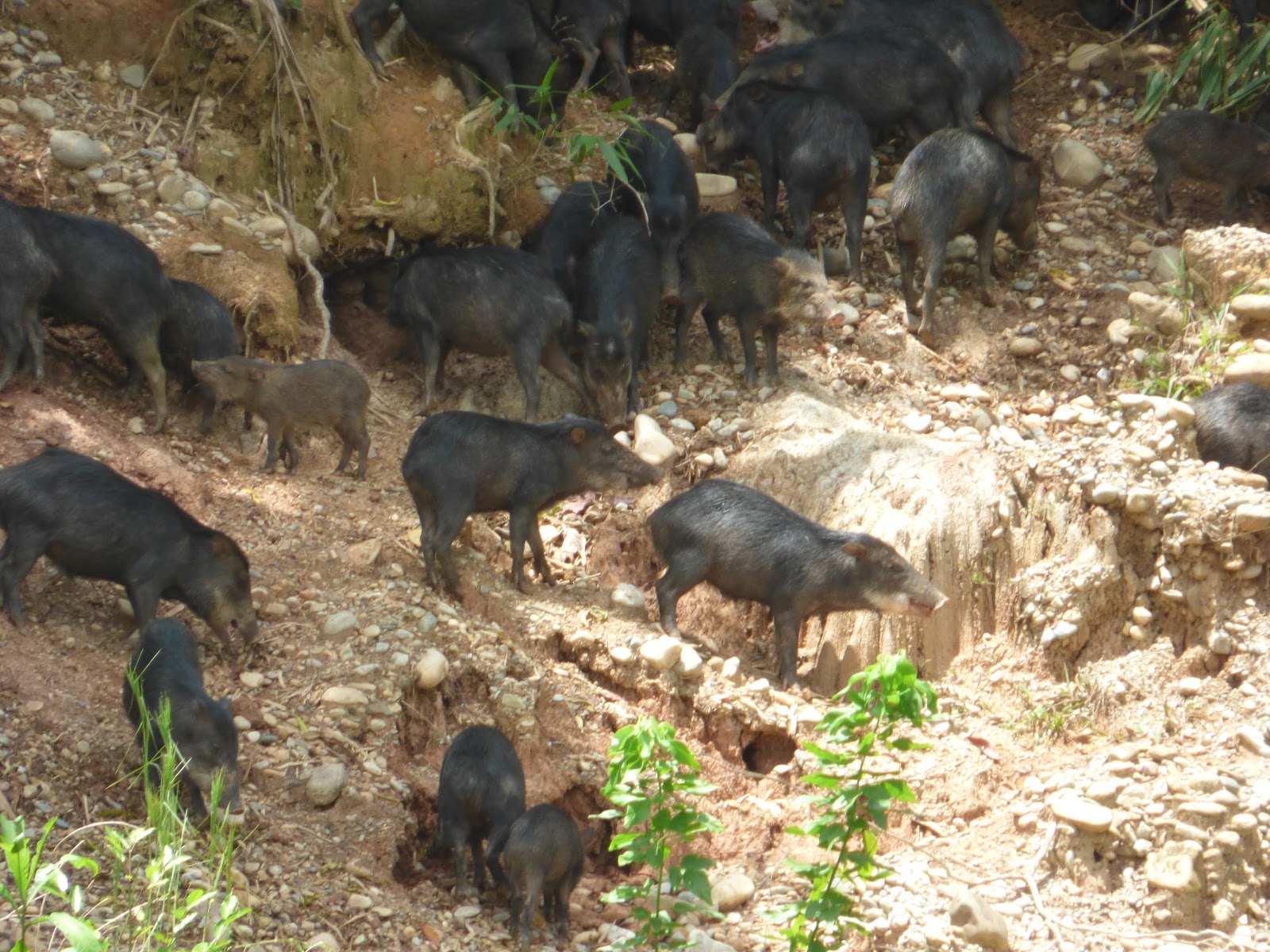
White-lipped peccary lookout male watching us as his herd pass, clacking his teeth together to scare us away


peccary herd at the clay lick


Dusky titi monkey baby with mama, her back to us


Photo of giant river otter in oxbow lake, following our catamaran, by Paul F Condori


Red howler monkeys


Howler

Monday, 4 September 2017

Some Birds of the Peruvian Amazon, research for Mama Amazonica

Great egret
To celebrate the publication of Mama Amazonica from Bloodaxe this September, here are just some of the birds I saw in the Peruvian Amazon, mostly on the Rio Tambopata banks, and in oxbows or around our lodge Tambopata Research Center. Such glory! The book may deal with trauma, but here is a counterbalance of beauty which I soaked up on my two trips to pristine rainforest. Here is what must be preserved, a world only partly visible, many species as yet undiscovered, unnnamed. Here is what I want to celebrate in my poems, along with the terror. 

Most of the photos were taken by Brian Fraser, a few by me with my iPhone, and our guide Jungle Paul took the super-sharp night-hawk.


crested oropendola


Rufescent tiger heron


Cormorant in Oxbow Lake


Black-tailed trogon


Roseate spoonbill


Red-capped cardinal


Azure gallinule


Blue-throated piping guan


Horned screamer


Mama hoatzin with chick in nest on fish pond in island


Night hawk on Tambopata photo credit Paul F Condori (Jungle Paul) our guide


Night hawks on the Tambopata, sleeping on driftwood

Monday, 3 July 2017

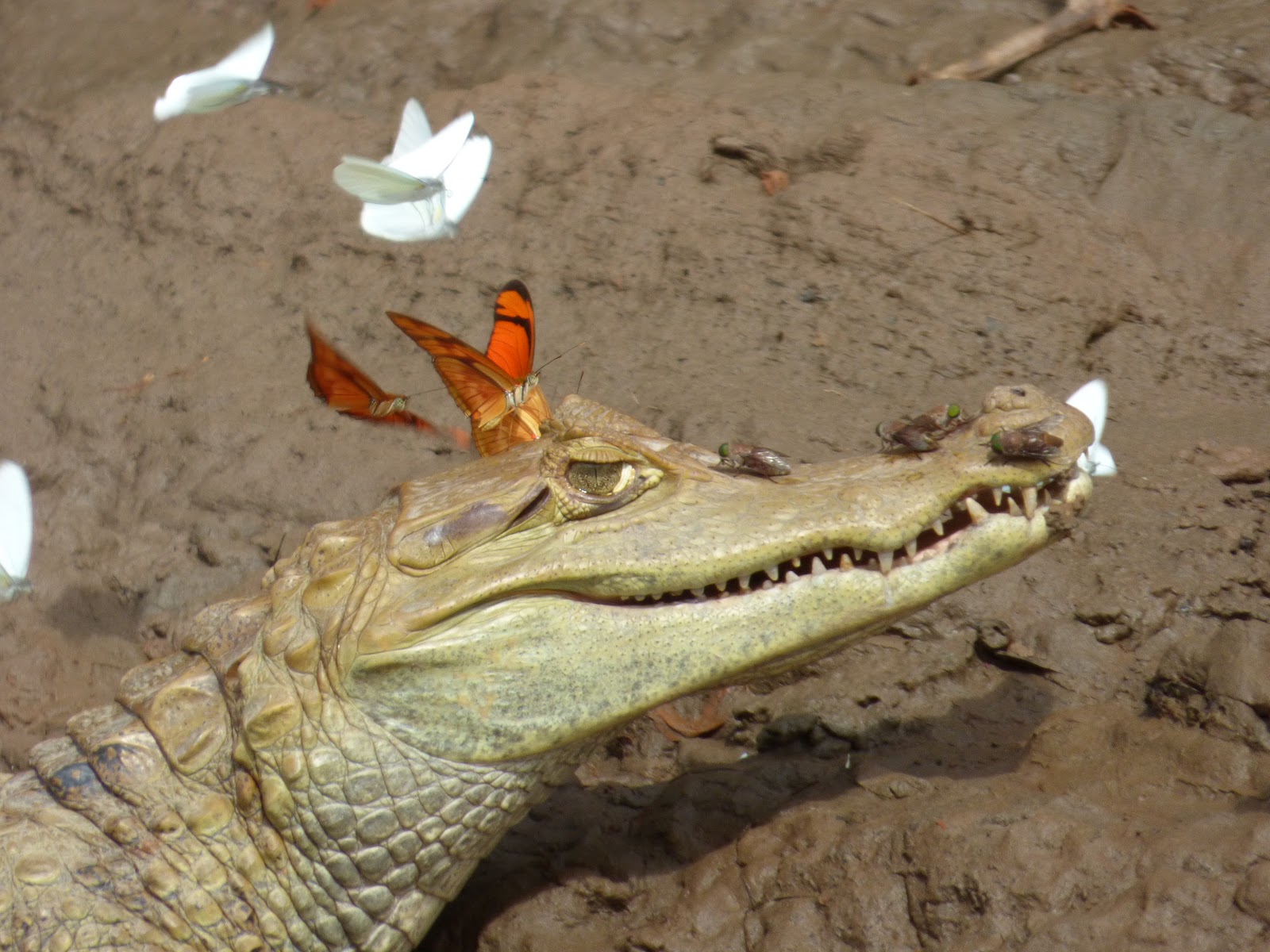
Black Caiman with Butterflies, Mama Amazonica and mental illness


 Mama Amazonica will be out later this summer from Bloodaxe, and I'm both excited and nervous. It's already available for preorder on Amazon! And the Poetry Book Society has selected it as their Autumn Choice, which is like a dream. Much of the writing of it was dreamlike, and came from my two trips to the Peruvian Amazon, and much of it came from the terrors of family trauma and mental illness, and a longing to make a book where I could love my psychotic and manic depressive mother. Mania, and depression – that old black caiman, haunt it, as in this poem 'Black Caiman with Butterflies'. The photos were taken by Brian Fraser, on the long journey up the Tambopata River, towards our lodge Tambopata Research Centre, deep in pristine rainforest only accessible by strict border checkpoints, no other lodge in the whole national reserve.


Black Caiman with Butterflies

Depression is a black caiman
lying on the sand,

mud-slicked from the deep,
impassive in her armour.

Nothing can get through to her,
she’ll lie there for hours, unblinking.

How to explain then
the appearance of butterflies?

Sparking flambeaux, snowy-whites,
at the corner of her eyes,

as if the beauty of the world has come
to perch on her, to drink her tears.

     (previously published in The Poetry Review)


Monday, 15 May 2017

Mama Amazonica now available for pre-order and is a Poetry Book Society Choice


Mama Amazonica is now available for pre-order, from Bloodaxe and Amazon etc. And to my utter delight and surprise is selected as the Poetry Book Society Autumn Choice. It exists – almost – all 112 pages of it. Publication date is 28th September, which happens to also be National Poetry Day!

Pre-order from Bloodaxe: HERE
Pre-order from Amazon.co.uk: HERE


Thank you to Neil Astley at Bloodaxe for encouraging me with it from the very beginning. It did take some courage to write. Here is the official book description:

Mama Amazonica is set in a psychiatric ward and in the Amazon rainforest, an asylum for animals on the brink of extinction. It reveals the story of Pascale Petit’s mentally ill mother and the consequences of abuse. The mother transforms into a giant Victoria amazonica waterlily, and a bestiary of untameable creatures – a jaguar girl, a wolverine, a hummingbird – as she marries her rapist and gives birth to his children. From heartbreaking trauma, there emerge luxuriant and tender portraits of a woman battling for survival, in poems that echo the plight of others under duress, and of our companion species. Petit does not flinch from the violence but offers hope by celebrating the beauty of the wild, whether in the mind or the natural world.


Saturday, 29 April 2017

On seeing a wild jaguar in the Peruvian Amazon for Mama Amazonica


The first time I went to the Peruvian Amazon last June, to Tambopata Research Centre in the middle of a vast protected national park, I hoped to see a jaguar. It's easier to see them in the Brazilian Pantanal, but I wanted to see one in the rainforest, so I knew I was asking the impossible. Everywhere we went we found traces: fresh pug-prints that I placed my hand inside, knowing he/she had just passed, we visited a farm where a jaguar was stealing the farmer's pet cats, other guides showed me photos of jaguars they'd glimpsed along the riverbanks. 

Our guide Berli said our only chance of spotting one was to travel up and down the river, so we booked a powered canoe to do this, but alas it rained hard in the Puna mountains, and the Tambopata river rose, bearing massive trunks downstream past our lodge, making the river too dangerous even with a navigator, so those trips were cancelled. Berli told me how he once was on the path by the boatmen's hut, when he came across a jaguar and a puma facing each other. Other guides said they'd seen them swimming across the river or darting among the bamboo stems above the rootmatted banks. I braced myself for the likelihood that a sighting would be brief.

I returned home not exactly disappointed, because I'd seen so much else: a harpy eagle, a tayra, black and spectacled caimans, all the kinds of monkeys endemic to the area, giant river otters. There was much material to weave into my collection Mama Amazonica, the Arts Council funded research was successful. I had precise sense-impressions of the fauna and flora, and the sounds of the forest, which at predawn are otherworldly, with the bats, pale-winged trumpeters, musician wrens, and howler and titi monkey crescendos. I felt I'd immersed myself in primary lowland forest where the mammal population is at its optimum, because no one else, apart from the scientists and guests of TRC, are allowed in the park. 

I could write new poems imagining my mentally ill mother as the Amazon rainforest – a journey I'd embarked upon because when I pictured her as animals and plants in the Amazon I was able to love my estranged parent. I wanted a book of this love and I wanted the book to burgeon and floresce, to be a place where the love would grow secretly, have its own eco-system, a memorial to her and to a vanishing wonder.

But a few months later I found myself dreaming of TRC again, a longing that wouldn't leave me alone until I'd booked another trip.

So I went in December, at the start of the rainy season, not the best time to go for rivertrips. But this time we saw even more wildlife than before: giant river otters again, coming up to our catamaran, capybaras mating on the river. We even saw two king vultures perched on the riverside on top of poles, another of my 'special' animals. Despite the rains, with some patience, we saw all the large macaws at the claylicks, and at Chuncho claylick one of the drivers said he'd recently spied a jaguar walking along the top of the cliff, over the clay caves, stalking the gold and blue and scarlet macaws. At the fishing pond I saw hoatzins with their chick in the nest, and at the mammal claylick we watched a harpy eagle chick, high up in the kapok tree nest. We passed roosts of nighthawks on riverlogs. We even came across pale-winged trumpeters on the paths at daytime, and our new guide Jungle Paul mimicked their song so they sang their extraordinary notes that I'd usually hear just before dawn, out in broad daylight. 


And so we came to the end of our trip and it was time to go back from TRC, downstream to the lodge in the buffer zone, Refugio Amazonas. We got up at 4 and were through the forest and on the river by 4.45, watching dawn slowly lighting up the banks, the unforgettable sight of steam rising from the trees and mist clearing from the river.

Several hours later we passed the checkpoint at the border of the national park, and that's when Paul whispered 'Gato!!!' Was it an ocelot? No, it was a jaguar! He was lying on a high log above a throne of driftwood, drying his coat after swimming across the rough river. He looked at us and did not move. The engine cut, and our boat gently rocked towards his shore. Paul, the motorista, the navigator and my husband Brian jostled on the narrow prow with their cameras. I sat sideways, facing him, focusing the binoculars. I looked with all my power. Afterwards Paul said we watched him for maybe 10-15 minutes before he descended and vanished, but it felt like hours, some of the best hours of my life, the air glistening like it did on my second wedding day.

The photo of the jaguar was taken by Paul Francisco Condori Vilca. 


Friday, 23 December 2016

Drama on the Tambopata River, Madre de Dios, Peruvian Amazon


You never know what dramas are unfolding on the Tambopata River in the Peruvian Amazon. We steered the canoe to photograph a great black hawk perched on a dead branch when our motorista  saw the huge golden catfish sticking out of the sandbank behind some driftwood. It was only when we got closer that we also saw the spectacled caiman, all two-three metres of him, though mostly he was slunk in the water, his snout in his prey. Our guide Paul Francisco Condori Vilca (aka Jungle Paul) took this photo and the close ups of the caiman's and catfish's heads below. My husband Brian photographed the hawk and the whole scene. They and the motorista and navigator all leapt onto the logs to take photos while I stayed in the boat. I can't leap easily off a narrow canoe prow, being hydrophobic. 

Paul explained that great black hawks prey on baby caimans. The hawk was no doubt waiting to feast on the catfish, but the spectacled caiman was waiting for the hawk to descend so he could catch the hawk! They stayed in this deadlock for about twenty minutes, then the caiman pulled the catfish under and re-emerged further back. The female horseflies on the catfish were also on the caiman's head,  they too were waiting for a meal. It was a spectacular find, and back at Tambopata Research Center that evening we toasted it with pisco sours before falling into bed at nine, for the usual four am rise.