Showing posts with label Tambopata National Park. Show all posts

Saturday, 9 September 2017

Some mammals of the Peruvian Amazon: research for Mama Amazonica

Capybara on Tambopata river
There are other mammals in Mama Amazonica – a wolverine, a snow leopard and two giraffes – but it's the Amazonian ones that I'm obsessed with. I love wolverines, have read everything about them, and watch the two at Vincennes zoo in Paris every time I go there, snow leopards are special though the only ones I've seen are in zoos too, and the herd of giraffes at Vincennes fascinate, but nothing comes close to jaguars for me. They are the pitbulls of the cat world, muscular, with jaws that could crack the moon, yet otherworldly, with their coats of stars or giant hooker's green waterlily leaves slowly drifting across a sunlit lake. 

I knew I would probably not see one in the rainforest, or at its margins along the riverbank. So I teased the guide and he humoured me, scheduling extra rivertrips on both of my visits to Peru. We saw so many creatures, and here are just some of them, along the banks or up in the treetops. But no jaguar. Not even an ocelot. 

Until the journey back from the research lodge deep in Tambopata National Reserve, back to the lodge in the buffer zone hours downriver. Scroll down and you can see him, and I've written about him before in a previous post. I've also tried to write about him in the last poem in Mama Amazonica, struck by Pablo Neruda's line "like a river of buried jaguars" from The Heights of Macchu Picchu. 

Imagine seeing a jaguar in his vast home, the place that takes hours to cross by plane!  


Photos by Brian Fraser and Jungle Paul


Capybara with cowbird


we find a jaguar!


Paul F Condori our guide Jungle Paul's photo


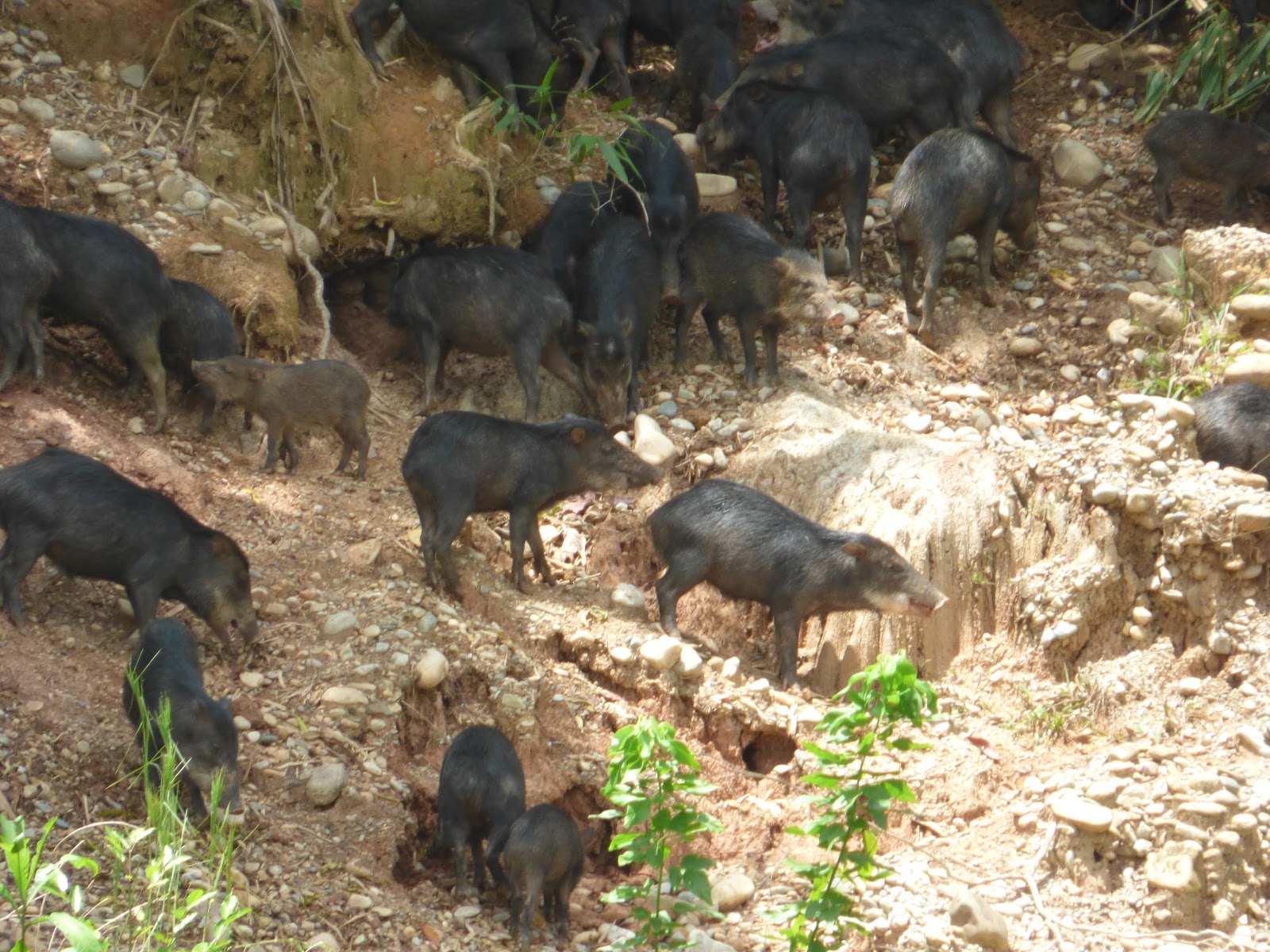
White-lipped peccary lookout male watching us as his herd pass, clacking his teeth together to scare us away


peccary herd at the clay lick


Dusky titi monkey baby with mama, her back to us


Photo of giant river otter in oxbow lake, following our catamaran, by Paul F Condori


Red howler monkeys


Howler

Saturday, 20 August 2016

Macaws at the Chuncho claylick, largest colpa in Amazonia, Tambopata National Reserve, Peru


Listening to macaws gathered in palms over a claylick must be the happiest sound on earth. In zoos they sound raucous, but in the wild, they are ecstatic, as they patiently wait for a safe moment to descend on what seems to be their shrine. The scientists at Tambopata Research Centre have been studying their behaviour at Chuncho claylick for years, and have various theories as to why the macaws, parrots and mammals all come here to eat the mineral rich clay. The cliffs at the side of the creek are carved into caves by their beaks. 

The first morning I was there, the macaws gathered in the trees while the mealy and blue headed parrots came down to feed first, flocks of them. The macaws are easily spooked, just the shadow of an eagle and they flew past, their tails streaming behind them, like blue, yellow and red sunrays. They gather always in twos or threes, monogamous, longlived couples with their single juvenile chick. Their calls are like the voices of sunrays passing through a delicious but dangerous planet. The claylick, or colpa, must contain sacred salts or minerals, essential for their health, but what I saw was how they worshipped it, perched for hours before descending. 

Even when they did dare settle, one would usually be a lookout, and I noticed that the lookout faced us over on the opposite side of the creek. They knew we were there and when one of our groups tired of waiting for them to come down and left, it was a signal. Then down they came, much to our delight; we'd been waiting since dawn and it was now noon. 

In the photos below you can see blue and gold macaws, red and green macaws, mealy parrots, blue headed parrots, and scarlet macaws. In the last picture, Laura from TRC and a scientist volunteer are with the tame wild scarlet macaws which were hand raised as chicks. They were once near extinction so the scientists removed the second chicks from nests (that the parents neglect so they die) and hand raised them. They nest up in ironwood trees near the centre and return for banana treats and reguarly steal the breakfast of guests. While I was there Tobasco stole my breakfast bun and the butter.