Last Monday I gave a talk to ninety 11-12 year olds at Lingfield Notre Dame School in Sussex, preparing them for their visit to Tate Modern the next day, when they were to write poems from art.While I was making a slideshow for them and researching for my workshop I fell in love with Ai Weiwei's Sunflower Seeds.I'm not sure what else to call it, but it does mean that I'm working on a poem about them, which is fun to do, even if it's no good.
I spent a day at the Tate, walking around the perimeters of the installation, looking down on them from the bridge, and watching the film of how he got a whole town in China to hand-paint a hundred million of the porcelain seeds in their husks. And wishing I'd seen the installation while you could still walk over or even bury yourself in them. En route to Sussex I hoped to find some sunflowers but it was Valentine's Day so the only flowers at the station were roses. But I did bring in a 800G bag of Dakota striped sunflower seeds, bought at my local Turkish international supermarket. The real seeds are huge, but Ai's are bigger than life and in the Turbine Hall they have an electrifying presence.
I passedthe seeds around and told the kids the story of how everyone in the town of Jingdezhen (which once made porcelain for imperial China) made the 100 million seeds over a period of two years. Also, how Ai had said that "In China, when we grew up, we had nothing...But for even the poorest people, the treat or the treasure we'd have would be the sunflower seeds in everyone's pockets."I asked them to keep a few of the seeds in their pockets.
They were a lively, excitable group, and in the space of one and a half hours, they all wrote three poems each, in response to various artworks at Tate. We started by playing the game of Surreal Definitions which creates instant surrealism, and instant metaphors, such as "a mirror is a pool of silver light", "the sun is something delicious in your mouth", some of them believable, some crazy, and some very funny. One boy's ended up as "a boyfriend is where most women keep their money". His neighbour had defined "a purse" then passed his definition on, so that the definition of "where most women keep their money" got joined to the noun "a boyfriend". And so on.
Another big hit was using Moniza Alvi's poem 'I Would Like to be a Dot in a Painting by Miro' as a template for their poems when I projected Miro paintings for them to pretend to be a shape in. They had very spirited responses to this, and saw all kinds of shapes – boomerangs, arrows, hexagons, and told imaginative stories about their relationship to other shapes in the paintings.
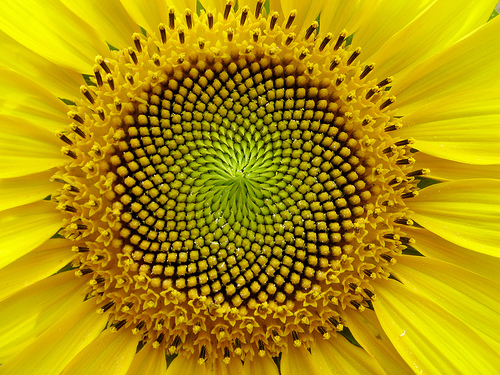
In one week my next Poetry from Art course (for adults) will start at Tate Modern, with two sessions in the wonderful Gabriel Orozco (see a previous post), then one in Ai Weiwei's Sunflower Seeds. Poems from the course will be published on the Tate Modern website in April. The art and English teachers of Lingfield school also hope to eventually publish a book of poems and drawings from the schoolkids' visit to the Tate and I'm looking forward to getting my copy. Meanwhile, here are some images of the sunflower seeds, fake and real, and a sunflower with the seeds packed in golden Fibonacci spirals.
Here is a recording of my entire reading at the 2010 TS Eliot Prize Readings in the Royal Festival Hall on 23rd January. This time last Sunday, I was nervously making my way to the Southbank and what turned out to be a two-thousand plus audience.Ian McMillan of Radio 3's The Verb introduced us all generously and warmly, welcoming us to that scary stage. I loved his joke about each poet speaking for only eight minutes, but not eight 'poetry' minutes.
The poems I read from my shortlisted collection What the Water Gave Me: Poems after Frida Kahlo were 'Remembrance of an Open Wound', 'What the Water Gave Me (V)', 'The Little Deer' and 'What the Water Gave Me (VI)'
The Poetry Book Society has recorded all ten of the shortlisted poets' readings and you can listen to them all on one page here. I'm looking forward to hearing them again, including Nobel laureate Seamus Heaney, and Nobel laureate Derek Walcott, the winner of this year's prize, whose poems were read by Daljit Nagra.
There are three more of my poems from What the Water Gave Me, and by each poet from their shortlisted collections, on the Guardian website.
Gabriel Orozco made 'Black Kites' when he was laid up at home with a collapsed lung. He painstakingly drew this black and white graphite grid on a real skull, and has commented on how intense it was for him to live with the skull over a long period. Orozco is a Mexican artist, so I immediately think of the Aztec Tezcatlipoca smoking mirror mosaic skull inlaid with turquoise and jet in the British Museum, and the lifesize rock crystal skull carved from quartz crystal, reputed to be Aztec, though this is disputed.
Elevator
Orozco is a playful, wide-ranging and inventive artist, with photographs, paintings, sculptures, and installations often featuring natural and found objects. A major retrospective of his work will open at Tate Modern next Wednesday, 19 January. I'm looking forward to my next Poetry from Art course which starts on 28 February and hope to spend one or two sessions in this exhibition. The course will culminate in publication of the participants' poems on the Tate Modern website. This course is booked out, but there are still a few places for the summer term, when the Miro exhibition will be on.
We live in a two-up two-down terraced house in East London and have a very small overgrown garden, but over the past year it has been inhabited by a menagerie of creatures, including in July a swarm of bees which nested temporarily in our jasmine laden buddleia. Foxes shelter in our collapsed shed and toads hide from our four cats under the understorey of campanula and ivy. Photos all taken by Brian. Happy 2011 to you all from us and the beasts who share our lives.
My Boxing Day was a harpy eagle research day. I am so fascinated by this creature that I can spend days trawling the web, reading about it. Like the king vulture, which I am also fascinated by, it's one of the gods of Venezuelan Amazonian tribes such as the Pemón, Warao and Yanomami. The Pemón live in the Lost World of the Guiana Highlands, near Roraima and Auyantepui. The Warao, or water people, live in stilt huts on the Orinoco Delta and the Yanomami live in south east Venezuela and north eastern Brazil. I've briefly visited the Warao and the Pemónand studied their lives and mythologies. The Pemón guide eco-tourists to the foot of Angel Falls in Canaima National Park in their curiara – traditional canoes powered by an outboard motor. They know the steep, rapid-strewn rivers of that breathtaking landscape intimately, as I discovered when we dodged rocks and rapids at full speed! They also guide groups up Mount Roraima, the highest of the tepuis or table mountains.
Their mythology includes much about the 'sky-world' – the plateaus of these giant prehistoric mesas. To ascend their spirit worlds in their myths they stick white harpy eagle down feathers in their hair. I don't know if they still do this, though I did climb Mount Roraima in 1995, and was aware that they considered it sacred and that we had to keep our voices quiet so as not to offend their spirits. The Yanomami sometimes raise a harpy eagle chick in a wooden cage for a supply of white down feathers to stick in their hair for ritual dress.
The female eagle is a third larger than the male and can even grab large howler monkeys from trees. I've posted this BBC documentary of a pair of harpies and their chick as I think it's quite extraordinary, especially towards the end, when the chick is almost fully grown (the team spent one year observing the nest), and the fledgling spends a lot of time watching the cameraman with intense curiosity. Since monkeys are pretty clever, he is going to have to learn how to outwit them so as to get enough to eat, and this film reveals the harpy's education as he observes the behaviour of his primate prey.
This is a quick post as I'm laid up in bed with flu, but very cheered up today by Ros Barber's review of What the Water Gave Me: Poems after Frida Kahlo and Val Robert's essay about my work. I find it encouraging to be favourably reviewed by a poet whose work I admire. Ros's latest collection Material, from Anvil in 2008, was a Poetry Book Society Recommendation. This is her author photo. You can become a fan of her work on Facebook. Here is an excerpt from her review:
"the book is as vibrant, and somehow life-affirming, as the paintings that inspired it. Petit’s Kahlo embraces life with all the joy of one who experienced being laid ‘on a billiard table’ while doctors ‘saw to the wounded, thinking me dead.’ There is an ecstasy in the agony."
There have been a lot of reviews and blogs about What the Water Gave Me since it came out last May, including one by Ruth Padel in The Guardian, one by Zoë Brigley in New Welsh Review and another by David Morley in Magma – three other poets whose work I admire. If you go to the book page on my publisher Seren's website you can click on links to read many of their reviews. WtWGM was also Jackie Kay's Book of the Year in The Observer. The collection was reprinted after only four months and I'm very excited that a US edition will be published by Black Lawrence Press in 2011.
Val Roberts is a third year creative writing degree student at Liverpool John Moores University. In her post 'The Wonderful World of Pascale Petit' she analyses two of my hummingbird poems, 'The Strait-Jackets' from The Zoo Father and 'Self-Portrait with Thorn Necklace and Hummingbird (I)' from What the Water Gave Me.I love it when people tell me things about my poems that I didn't quite register myself, but that's what she manages to do, especially in her study of the sonic echoes in both poems, and indeed, in her study of the thematic echoes, which she does very precisely, as shown in this excerpt from her analysis of 'The Strait-Jackets': "For the first time since she arrived he starts to breathe more easily with that hummingbird metaphor, which is a soul of an injured person. Notice the subtle internal rhymes with the words ‘breathe’ and ‘easily’ and the echo of ‘recycler’ and ‘cannula’ which is attached to his nostrils as it almost slips out. This is an important part of the poem as the cannula almost slips out. This is perhaps where realisation may hit. It makes one wonder what else almost slips out. Perhaps Petit has spoken some truth about her and her father’s relationship. This is the pure brilliance of Pascale’s poetry. She says I don’t know how long we sit there, such a powerful line and in particular with the internal half rhyme and echo of language. One does not know how long she has sat there. One does not know what has gone on."
Here is the poem'The Strait-Jackets'. I love how she's accurately connected the hummingbird theme in this poem to the Frida Kahlo poem, where I am both writing about Kahlo's efforts to overcome her bus crash but am also coming to terms with my own childhood trauma through Kahlo's painting 'Self-Portrait with Thorn Necklace and Hummingbird'.
This is the photo of forty hummingbirds in a suitcase which inspired 'The Strait-Jackets'. The Brazilian ornithologist Augusto Ruschi's stowed his birds in a suitcase to transport them on plane flights, by lowering their temperature and placing them in a torpor (which hummingbirds go into at low temperatures to conserve energy). While they were asleep he wrapped them in pyjamas to protect their wings. Then he used to warm them up before releasing them once he reached his destination.
And here is Frida Kahlo's painting 'Self-Portrait with Thorn Necklace and Hummingbird'. It's the first painting I wrote into a poem in What the Water Gave Me. The whole book grew from this defiant self-portrait with a dead hummingbird hung from a necklace of thorns made from Christ's crown:
Mir Mahfuz Ali is shortlisted for the 2010 Picador Poetry Prize and is included in the groundbreaking anthology Tenfrom Bloodaxe. Ten, edited by Bernardine Evaristo and Daljit Nagra, is the culmination of Spread the Word's two year initiative to support talented new black and Asian poets.I had the good fortune to mentor Mahfuz for this project, and what a dream job it was.
Mir Mahfuz Ali was born in Dhaka, Bangladesh in 1958. He grew up during the war of liberation and came to England in 1973, after being shot in the throat by riot police during an uprising. As a performer, he is renowned for his extraordinary voice – a rich, throaty whisper. His poetry has appeared in PN Review, Poetry London, London Magazine and Ambit. He has also been shortlisted for the New Writing Ventures Awards in 2007. His poetry combines a luxurious Bengali linguistic richness with the trauma and first hand testaments of the atrocities of war.
Read his poems in Ten, and all the exciting poets in this anthology, described by Carol Ann Duffy as "ten sparkling new talents who demonstrate the richness, energy and confidence of the poetic voice in our multicultural country". This book is groundbreaking, necessary, but most of all, an enthralling read. Here is one of Mahfuz's poems: Midnight, Dhaka, 25 March 1971
I am a hardened camera clicking at midnight.
I have caught it all – the screeching tanks pounding the city under the massy heat, searchlights dicing the streets like bayonets. Kalashnikovs mowing down rickshaw pullers,
vendor sellers, beggars on the pavements. I click on, despite the dry and bitter dust scratched on the lake-black water of my Nikon eye, at a Bedford truck waiting by the roadside, at two soldiers holding the dead by their hands and legs, throwing them into the back, hurling them one upon another until the floor is loaded to the sky's armpits. The corpses stare at our star's succulent whiteness with their arms flung out as if to bridge a nation. Their bodies shake when the lorry chugs. I click as the soldiers laugh at the billboard on the bulkhead: GUINNESS IS GOOD FOR YOU SIX MILLION DRUNK EVERY DAY.
Pascale’s ninth collection, Beast, published by Bloodaxe in 2025, was a Poetry Book Society Recommendation. Her eighth, Tiger Girl, published by Bloodaxe in 2020, was shortlisted for the Forward Prize for Best Collection and for Wales Book of the Year. A poem from the book, ‘Indian Paradise Flycatcher’, won the Keats-Shelley Poetry Prize. Her seventh collection, Mama Amazonica, published by Bloodaxe in 2017, won the inaugural Laurel Prize 2020, the Royal Society of Literature's Ondaatje Prize 2018 and was a Poetry Book Society Choice. Pascale’s sixth collection, Fauverie (published by Seren), was her fourth to be shortlisted for the T. S. Eliot Prize and five poems from it won the Manchester Poetry Prize. Her books have been translated into Spanish, (in Mexico), Chinese, French and Serbian. Pascale has had three collections chosen as Books of the Year in the Times Literary Supplement, Independent and Observer. In 2015 she received a Cholmondeley Award and in 2017 an RSL Literature Matters Award. She is a Fellow of the Royal Society of Literature.




 Posts
Posts


