Friday, 6 July 2012
A Poem for Frida Kahlo's Birthday, 6 July 2012
The Wounded Deer or The Little Deer is my favourite painting by Frida Kahlo. She painted it for her surgeon, after he operated on her spine, but the surgery failed. It's a portrait of her pet fawn Granizo ('Hailstones') but she has given him her face. There is so much that fascinates me about this portrait: the Catholic reference to St Sebastian, the fact that she is a male stag with antlers, and the symbolism of the numbers nine and ten (nine arrows, nine tines, ten trees, ten branches). But when I saw it at Tate Modern to read the following poem in front of it, what struck me was how small and faint the painting is, as if it's about to disappear.
The Wounded Deer
I have a woman's face
but I'm a little stag,
because I had the balls
to come this far into the forest,
to where the trees are broken.
The nine points of my antlers
have battled
with the nine arrows in my hide.
I can hear the bone-saw
in the ocean on the horizon.
I emerged from the waters
of the Hospital for Special Surgery.
It had deep blue under-rooms.
And once, when I opened my eyes
too quickly after the graft,
I could see right through
all the glass ceilings,
up to where lightning forked
across the New York sky
like the antlers of sky-deer,
rain arrowing the herd.
Small and dainty as I am
I escaped into this canvas,
where I look back at you
in your steel corset, painting
the last splash on my hoof.
From What the Water Gave Me: Poems after Frida Kahlo
available from Seren in the UK and Black Lawrence Press in the US. Also available from Amazon UK and Amazon US.
Tuesday, 3 July 2012
Poetry from Art at Tate Modern: Touch Tour in Poetry and Dream 2012
On our fourth session of my Image-Making: Shaping Poems course at Tate Modern we were given a Touch Tour by Marcus Dickey Horley, who usually only does this for partially sighted or blind visitors. We got to touch the three sculptures available for this tour at Tate Modern: Alberto Giacometti's Walking Woman, Henri Laurens' Autumn and David Smith's Home of the Welder, or 'the man's doll's house' as we nicknamed it.
Four of us at a time could touch the bronze Autumn by Henri Laurens. Touching can only be done through lint free gloves but it's amazing how much you can feel through them. To write about the experience I handed out my Mental Imagery list of eight senses: sight, touch, hearing, taste, smell, the organic or inner body sense, kinesthesia and synesthesia. I also brought Keats' 'Ode to Autumn'.
Here is Marcus introducing us to David Smith's Home of the Welder, behind him, so fragile (like a man's doll's house) that only one of us at a time could feel it.
Karen McCarthy Woolf touching Home of the Welder which is welded together.
Only two of us at a time could touch Giacometti's bronze Walking Woman, she is so thin! At one point Giacometti had given her arms and a head; one arm ended in feathers and the other in flowers, and her head was a cello. This was while she was still made of plaster. The final cast form is classic and archaic, and we discussed Tishani Doshi's poem 'Ode to the Walking Woman' where she becomes various ancient earth and sky goddesses, including Astarte, Cybele, and figures from a 3000BC archaelogical site in Pakistan, who are invited to "Sit / you must be tired" and "resurrect yourself, /make love to the sky, / reclaim the world."
Autumn by Henri Laurens (Bronze, 1948)
Tuesday, 26 June 2012
Poetry from Art at Tate Modern: Ewa Partum's Active Poetry
![]() |
| Choosing 10 words from the circle, photo by participant Anne Welsh |
Chance plays a large part in Polish artist Ewa Partum's situational poetry installations. Her video installation at Tate Modern, Active Poetry, is from the '70s, and was groundbreaking then. She scattered letters from Joyce's Ulysses and other seminal works in landscapes such as seashores and woods, and let the elements rearrange them into poems of a new random language. She was also a feminist and appeared naked in her own performances as a protest "until women are equal in art".
![]() |
| Active Poetry still from video by Ewa Partum |
"fire is an elixir giving immortality"
"a cigarette is something that stops your head exploding"
"a bone-saw is a prayer suspended in glass"
"scissors are sweet and heal wounds"
"an insect-o-cutor is sheer bliss"
"a skull is your enemy"
"a black sun is a terrible pool"
"an eye is a device to electrocute insects"
"a wing is a hypochondriac's larder"
"honey is a total eclipse of the sun"
We discussed 'collage' or 'mosaic' poems, where disparate phrases and images are clustered together in a non-linear way, but somehow have an underlying cohesive whole. I read out Yang Lian's poem 'The Winter Garden 1' from the anthology Jade Ladder: Contemporary Chinese Poets, which appears to be a collage of surreal images and contains lines like "the hurried night always wears brand new soles" and "the vole is an exhausted nurse stealthily/slinking into the garden's wounds". Another fantastic example of a 'collage' poem is by Karen McCarthy Woolf who is in our group, 'The Weather in the Womb' (from Ten: New Poets from Spread the Word).
Everyone had to pick 10 words out of the circle, avoiding their own, and use one surreal definitions line as a lynch pin. They arranged their selections on the floor until the configuration started a short poem. They could of course insert other words to make grammatical sense, and add anything that came to mind. It was fascinating to see which words people had brought in, and how much they wanted to avoid their own, perhaps overused, 'pet' words. Also interesting to see who rushed to have the widest choice and who waited until the pool had shrunk. I suggested they close their eyes and just grab them.
![]() |
| Anne Welsh's photo of her 10 words and surreal definition on the floor |
After ten minutes of writing everyone read back their poems. It's a large group (twenty-three last night), and they have become adept at doing this fast and loud, against the gallery's bad accoustics.
They only had twenty minutes left of the one-and-a-half-hour session to form into small groups for friendly feedback on a poem they'd brought in from the term. Homework was to cut out a line from tonight's poem and place it in an environment – a garden, a wall, a shop, an office etc – and to return to it a few days later to see what happened to it and if that might add to the poem.
Wednesday, 20 June 2012
Poetry from Art at Tate Modern: Damien Hirst's Anatomy of an Angel
"Every angel is terrifying", Rilke wrote, when he started his Duino Elegies. Damien Hirst's angel is no exception, being a hybrid of a kitsch snow-white Carrara marble beauty and an anatomy-lesson mannequin where the skin is cut away to reveal the internal organs and the skull. We set up our chairs around her for the second week of my Poetry from Art course in the Damien Hirst exhibition.
But before attempting 'angel' poems we went on a lightning tour of a few key exhibits in the show, just us and the full glory of Mother and Child Divided (where I pointed out the furry snout of the calf foetus inside the dissected cow), and the shark in its tank of turquoise formaldehyde. I steered the group away from the rotting cow's head and insect-o-cutored flies vitrine, since it wasn't looking its prettiest, past the pongy giant ashtray titled Crematorium, back to the end of the galleries, to the room adjacent to the angel. In many ways this room, containing both Black Sun and Black Sheep, is the antithesis of the angel-and-butterfly-mosaics display. Black Sun is a large circular black 'painting' made entirely of stuccoed flies in resin. I think it's one of Hirst's most inventive and evocative pieces, with its references to Beelzebub and black holes or anti-matter.
We read Selima Hill's poem 'See the Flies' and 'Sheep', both full of black humour, to see ways of writing responses that could be short, intense, oblique, personal, or funny. Our last vitrine was The Incomplete Truth, a perfectly preserved dove flying in formaldehyde, seedpearls or air-bubbles glistening around its claws.
Here, I read out the Spanish/Argentinian poet Rafael Alberti's poem 'Dove', where everything is as reversed as Hirst's harbinger in its poisonous element, and the dove "to travel north she flew south.../ Believing the sea was sky, / That the night was dawn."
Back in the angel room we discussed Rafael Alberti's poems 'The Angel of Numbers' and 'The Good Angel', and recited the list of inspiring poem titles in his collection Sobre los Angeles (Concerning the Angels). Everyone particularly loved 'The Angel of Numbers' for its unexpected juxtaposition of maths with angels. We also read Selima Hill's funny 'Portrait of My Lover as an Angel' and the darker 'Love is Like a Terrifying Angel' from her fabulous collection Gloria: Selected Poems. This brought us back to Rilke, so I read out the first two stanzas of 'The Second Elegy' from The Duino Elegies to get us into writing mode.
They had just twenty minutes to write an angel, fly, dove or a cow poem, perhaps borrowing an approach from one of our examples. Our sessions only last one and a half hours so it's a bit of squeeze but we not only managed to hear everyone read back their excellent poems but also played a quick Hirstian instant surrealism game to close, a variation on the Surrealist Definitions game. I had collected 26 nouns (such as 'insect-o-cutor', 'pharmacy', 'fly') from the exhibition and printed each one on a strip of paper. These were folded up in a chocolate box, and selected at random. We had to briefly define our noun then tear the definition away from it and hand the definition to the person on the left so they had a different definition for their original noun. It worked wonderfully, and I've asked everyone to bring in their surreal definitions in next week, to use in the Ewa Partum video session, when we will be working with lots of word scraps on paper as she does.
At the end of each session we go upstairs to the Members' Bar for free drinks, and as it was a balmy evening we sat out on the terrace overlooking the Millennium Bridge and St Paul's, listening to the terrifying screeches of two peregrine falcons on the Tate Modern roof.
Tuesday, 12 June 2012
Poetry from Art at Tate Modern: Damien Hirst's In and Out of Love
Last night was a memorable start to my summer course of Poetry from Art, in Damien Hirst's butterfly room In and Out of Love. The team at Tate Modern went to enormous lengths so that we could be there, as there was high maintenance going on in the rest of the show, including in A Thousand Years, the cow's head and hatching flies vitrine. We shouldn't really have been there but negotations went on (and on) and finally it was decided that we could enter our rooms, Pharmacy, as well as the butterflies, through a 'blue' back route, so the group got to see some secret corridors. We were then escorted directly into the butterfly room, which was so mesmerising that I had to coax everyone to come out the other side to our circle of chairs in Pharmacy.
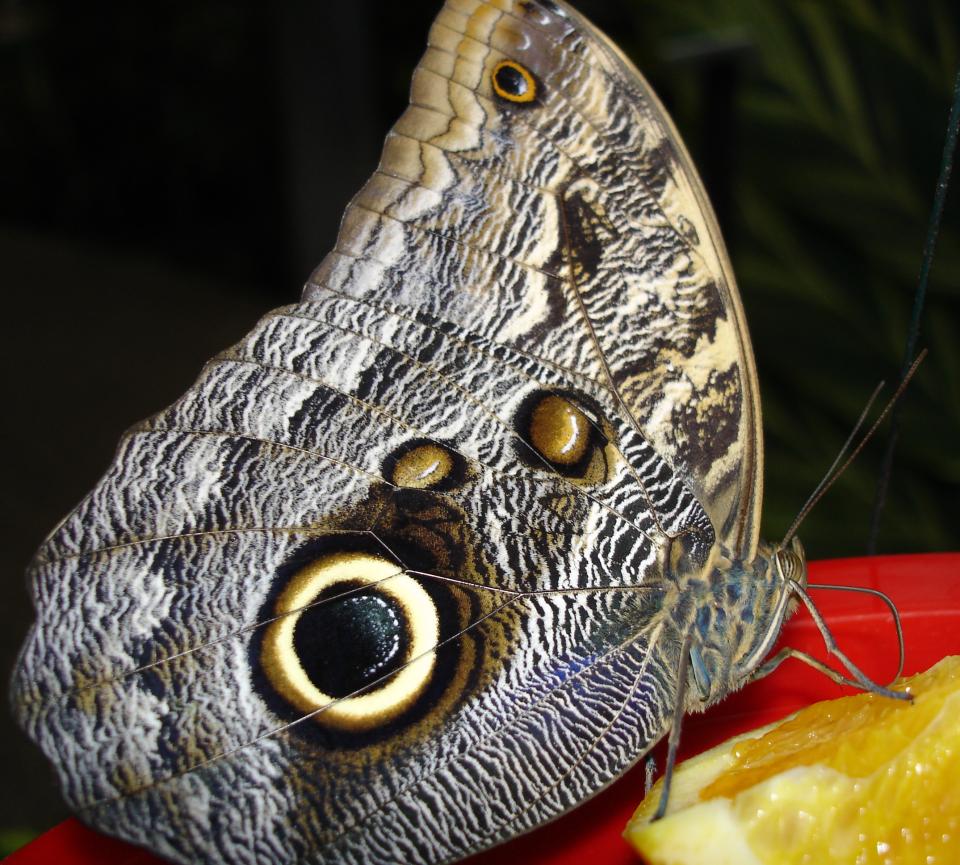
Twenty-four of us sat assimilating the sensation of having giant tropical butterflies settling on us and tickling our arms. One owl butterfly escaped into Pharmacy with us but luckily he decided to land on me so I walked him back 'home' carefully through the translucent curtain strips. We divided the group into two halves, so half went straight back in, with notebooks and pens, to free-write, while group B stayed for discussion, then we swapped over.
We talked about Hirst's installation, and discussed three butterfly/moth poems: 'Monarchs' by Sharon Olds, and 'In the Pharmacy' and 'Tapestry Moths' by Peter Redgrove. All three poems combine the image of a moth or butterfly with something unexpected. This course is titled Shaping Poems: Image-Making, so we explored the idea of shaping a poem with two images clashed together. Olds' poem merges the Monarch butterfly with a first sexual encounter and a man with hands "like butcher's hands". Redgrove literally has his moths on a tapestry, so that they fly off, taking details of the scene away on their wings, laying parts of the pictures they've eaten into their eggs. Fragments of the tapestry pictures even end up in bats who eat the moths. In 'In the Pharmacy', a moth "like a travelling label walks/ From bottle to marble bottle with floury wings/ Embracing each and tapping with fernleaf tongue" on pharmaceutical bottles in a chemist's and we thought there was a juxtaposition between the chemistry of medicines and the metamorphosis inside a chrysalis. This was particularly apt because we were surrounded by a wall to wall pharmacy.
I think it's hard to write about butterflies. I remember being told that they were a subject to avoid in poems. But butterflies have supersenses. Morphos (which I've seen flying in the wild in the Venezuelan Amazon), have ears at the base of their metallic blue wings. When they flap lazily in the tropical sunlight they look like lightning flashes, and it's thought that this may be a form of defence, since one of their predators is baby jaguars, who catch them in play, much as my cats catch butterflies for snacks. They flash their iridescent wings to dazzle their prey. Butterflies taste with their feet, and maybe when they were settling on us it was to taste their evening visitors. Some pupae squeak when disturbed, so there could be a world of butterfly language yet to be discovered. They see more colours than we do too.
Our session was shorter than usual because of the winding back route to the rooms so the group had even less time to write, only 10 minutes after the note-taking in situ, but already some butterfly poems are pupating. Next week we will be in another part of the Hirst exhibition. I ask that they come with fresh eyes, try to disregard the hype and criticism about this artist. The show is full of invention. For me, it's a dream, stuffed as it is with curiosities of natural history and echoes of Catholic iconography, which must come from Hirst's childhood Catholicism.
Tuesday, 5 June 2012
Serbian edition of The Zoo Father with illustrations: Belgrade Poetry Festival
This is the cover of the Serbian edition of The Zoo Father, published by Treci Trg and launched at the Belgrade International Festival of Poetry, May 30 – June 3, which Treci Trg also organised. I was astonished when my translator Milan Dobricic emailed me the images designed by Dragana Nikolic. She seems to have captured the spirit of my book and to have added something extra. There was an exhibition of the cover and the eleven illustrations during the four-day festival.
Apart from the chance to visit Belgrade, which I'd not seen before, this was also an opportunity for me to listen to the other guest poets, and make new discoveries, such as Vladimir Martinovski from Macedonia and Turkish poet Gokcenur C, both so fresh they made me want to write then and there, if the programme hadn't lasted until the early hours each night. Martinovski is not yet translated into English but he should be.
The Zoo Father, which was published in the UK by Seren in 2001, is currently out of stock but about to be reprinted and made available as an e-book. It has also been published in Mexico in a bilingual Spanish/English edition by the publisher El Tucan de Virginia in 2004.
Illustration for 'The Strait-Jackets'
'The Strait-Jackets' to read the poem in English click here
Illustration for 'My Father's Voice'
Illustration for 'King Vulture Father'
'King Vulture Father'
Illustration for 'Trophy'
'Trophy'
Illustration for 'My Octopus Mother'
Illustration for 'My Father's Clothes'
Saturday, 19 May 2012
Chateau Ventenac poetry course 2012
Minerve on the Gorge du Cesse (see tiny people on the dry riverbed)
One
of my top places in the world is the Languedoc Roussillon in the south
of France, so teaching a poetry course there is a dream. Last week, for
six days, eleven poets joined me at Chateau Ventenac for Making Worlds, my third course at the Chateau. They came from London, Palm Springs, LA, Colorado, Stafford and Herefordshire. We
spent the mornings in creative workshops, the afternoons free (though
everyone had two tutorials with me so I was busy), and in the evenings
there were writing games and readings. Unlike Arvon courses we were
catered for – the meals were exquisite.
It was during the afternoon tutorials, while we sat under the awning by the pool on the bottom terrace, that a nightingale perched over us and sang. I knew instantly that it was the bird in Keats' ode (the poem that switched me onto poetry when I was a teenager). The notes sounded like gurgles blown in glass, breaking through to our world from another dimension – they were piercing and ecstatic. The next day he returned and sang for longer. Justina wrote that it was "like a star running down your throat". The phrase is one from a series of lines from cosmological myths that I supplied the first evening, for them to incorporate into a short poem.
I also brought along a hoard of surreal contemporary art cards to kick-start poems, and animal fact-files which I bought from Oxfam, meant for children, but those have the most fascinating facts! These included info about the hoopoe, who also sang for us regularly, pipistrelles, which swooped over the veranda each evening, the grass snake, hares and owls. Inside each file I'd inserted another sheet about myths associated with each animal. The prompt was to write a poem which included some biological facts about the creature (handed out to everyone at random), which somehow resonated, some mythological aspect, and something personal (as well as free-associations). Perhaps the poet wished to tackle a difficult subject they could dress in an animal mask. One of the examples we discussed before starting was Joy Harjo's poem 'She Had Some Horses'. They could also try her use of repetition and hypnotic chant to build momentum.
It was during the afternoon tutorials, while we sat under the awning by the pool on the bottom terrace, that a nightingale perched over us and sang. I knew instantly that it was the bird in Keats' ode (the poem that switched me onto poetry when I was a teenager). The notes sounded like gurgles blown in glass, breaking through to our world from another dimension – they were piercing and ecstatic. The next day he returned and sang for longer. Justina wrote that it was "like a star running down your throat". The phrase is one from a series of lines from cosmological myths that I supplied the first evening, for them to incorporate into a short poem.
I also brought along a hoard of surreal contemporary art cards to kick-start poems, and animal fact-files which I bought from Oxfam, meant for children, but those have the most fascinating facts! These included info about the hoopoe, who also sang for us regularly, pipistrelles, which swooped over the veranda each evening, the grass snake, hares and owls. Inside each file I'd inserted another sheet about myths associated with each animal. The prompt was to write a poem which included some biological facts about the creature (handed out to everyone at random), which somehow resonated, some mythological aspect, and something personal (as well as free-associations). Perhaps the poet wished to tackle a difficult subject they could dress in an animal mask. One of the examples we discussed before starting was Joy Harjo's poem 'She Had Some Horses'. They could also try her use of repetition and hypnotic chant to build momentum.
On the third writing morning we changed tack and stopped using images and texts to generate poems, and instead went for a walk along the Canal du Midi, with the golden rule that although they could chat en route to the Pont-Canal two kilometres away, they had to be silent on the return. The process was to be like the contrast between Gauguin and Van Gogh's working methods: Gauguin painting from his imagination (as we had been doing indoors so far) and Van Gogh from direct observation outdoors. The group could respond to one object along the way back through all eight senses, paying close attention to it.
Midway through the week, we had a day off and went to the medieval Cathars citƩ of Minerve, which leans over the intersection of two limestone gorges: the Cesse and the Brian. After a leisurely lunch in the Troubadour restaurant overlooking the gorge we wound down to the stony bed, hoping we could wade through the cave which connects the two almost-dry rivers, to a secluded valley the other side, but the water was too deep. So they explored the limestone cliffs and listened to the birds. I sat on a bank and read work for the following day's tutorials in this idyllic setting. Next year's course will also be in May, and I've already bagged my tutorial space down by the 'nightingale' bush.
At the seventeenth century Canal-Pont, the first built in France, where the canal crosses a river
The cave tunnel between the two gorges below Minerve
From left to right: Maria Elena Boekemeyer, Stephen Linsteadt and Lois P Jones on the gorge bed at Minerve
The Canal du Midi
Moi in front of the bridge over the Cesse Gorge, entrance to Minerve
Katrina Naomi with matching shutters and door at 1, La Caunette, another medieval village by Minerve
ApƩritifs on the terrace each evening
Writing game with the drinks!On the last evening a few locals and some of our helpers came to the reading by the group. Here is Jinny Fisher reading two of her poems from the week. Everyone read work written on the course. Next to Jinny is Julia Bristow (owner of the Chateau), Philip, Susan, Mary and Justina
The residents of the canal. There were also otters and ducklings.
Justina Hart and Carl Burness on the terrace
Subscribe to:
Posts (Atom)