Tuesday, 15 March 2011

Ai Weiwei's Sunflower Seeds and Yang Lian's porcelain poem


For our third session of Poetry from Art at Tate Modern we worked in the Turbine Hall, with Ai Weiwei's Sunflower Seeds installation. These 100 million sunflower seeds have been individually handcrafted over two years by the artisans of the city of Jingdezhen, famed for its production of Imperial porcelain. Ai Weiwei has spoken about how the work is a commentary on the 'Made in China' phenomenon. I brought the poem 'Father's Blue & White Porcelain' by the 'misty' poet Yang Lian as a way in for the group to write about the installation. Yang Lian, who now lives in London in exile from China after the Tiananmen massacre, is as experimental an artist, and like Ai his work engages in a critical dialogue with Chinese tradition and history. 

First, we watched the 15 minute film Tate made of how the porcelain sunflower seeds were manufactured, from the men mining and pounding the kaolin to the women expertly painting each seed in three or four strokes, Ai there among them, answering tweets on his mobile phone as he chatted. He is an unpretentious teddybear of a man and his warmth somehow made the installation more accessible and human-scaled. We then returned to the Turbine Hall bridge and I passed around some large striped, black sunflower seeds from Dakota, bought at my local international store, to feel as we discussed Lian's poem:


Father's Blue & White Porcelain

a small jar of night      a thousand frontiers carrying him
the sky of old age continues the firing in the kiln
continues arranging this pot plant      lamplight
a glazed hand      refines a blue cough
in his flesh he embroiders the fragile whiteness of posterity
turns around a thousand times      the little
room a snake's stomach swallows the longest diameter of life
his night-long waking      like the sleep-talk of the whole world

awake and not looking at humans      not even waiting for
a cup of darkness tea      four walls softly slide up
a small iron table sinks in to a venom-coated shaft
another red-hot circle sealing
his book      its unread wings tightly closed
how many bloomings and fadings of seventieth birthdays have been fondled
startling a container with petals that cannot be rubbed away
lying down      revealing again the birthmark of day  
  
Yang Lian translated by Brian Holton
Riding Pisces: Poems from Five Collections (Shearsman, 2008)
  
A few of us thought there was the ghost of Keats' 'Ode on a Grecian Urn' when we looked at the way the father and his room are overlaid on and in the porcelain in a double exposure, the human pageant in the glaze. The images start out ordinary enough, but they soon morph: "a jar" turns unto "a jar of night', "tea" is a "a cup of darkness tea". Someone pointed out that the poem contained a deep well of history in it, both through the tradition of porcelain and in the layering of the past in the complex images: "the sky of old age" and "bloomings and fadings of seventieth birthdays". 

I asked the group to sit around the Sunflower Seeds installation and write a poem about it incorporating one phrase from Lian's poem, such as "a glazed hand", "the sleep-talk". As his poem is made in a collage mosaic of images and thoughts, I wanted them to start a collage poem. I then read out quotes by Ai Weiwei when he was interviewed by Juliet Bingham and Marko Daniel (Tate curators), such as:

"In China, when we grew up, we had nothing... But for even the poorest people, the treat or the treasure we'd have would be the sunflower seeds in everybody's pockets."

"For me, the internet is about how to act as an individual and at the same time to reach massive numbers of unknown people.... I think this changes the structure of society all the time – this kind of massiveness made up of individuals."

As well as a phrase from Lian's poem, the group also had to incorporate a phrase from something Ai Weiwei had said in the interview. Homework was to carry on searching for phrases to include in a collage poem. They could find them from failed poems, notebooks, letters, anywhere. Then to print the results large, cut up the lines and rearrange them until they made a new sense. Some of the results will be published next month on the Tate Modern website in an online anthology of poems written this term.


Wednesday, 9 March 2011

Celebrating Frida Kahlo on International Women's Day at Monmouth


Yesterday I gave an illustrated reading from What the Water Gave Me: Poems after Frida Kahlo for Monmouth Women's Festival to celebrate International Women's Day. The Monmouth Shire Hall was packed to capacity even though the tickets were £15 (the event included a delicious Mexican buffet lunch. I gave a 45 minute reading and talked about Kahlo's extraordinary life and paintings, showing the paintings each of my poems is based on. There were many Frida fans in the audience and some had travelled quite far to attend, not least my editor from Seren, Amy Wack, who, despite her busy schedule, comes to many of her authors' readings. Amy took this photo of me signing books.

It felt right to celebrate Kahlo on International Women's Day, and include my poems about those radical paintings My Birth and Henry Ford Hospital with their depictions of childbirth and miscarriage which still have the power to shock. So when Mandi, one of the festival organisers, asked me later as she was driving me back to Newport train station, if I thought Kahlo was a feminist, I replied yes.  Feminism as such wasn't yet a defined movement when she was painting (she was born in 1907 and died in1954), but what makes her so groundbreaking as an artist is how she bravely painted exactly what she wanted to paint, how she wanted to paint it, regardless of anyone else's approval. Which makes her a great role model. 


 Henry Ford Hospital (The Flying Bed) Frida Kahlo 1932

Tuesday, 1 March 2011

Poetry from Art at Tate Modern: Week 1 Gabriel Orozco


Last night my new Poetry from Art course started at Tate Modern. We are spending the first two weeks in the Gabriel Orozco exhibition and what a gift it is for poets. We sat in the hub room, between La DS and the Elevator, all twenty-seven of us. After introductions and a wander around the show we had a close look at Black Kites (see above), a real skull that Orozco painstakingly drew on with graphite while he was convalescing from a collapsed lung. I read out Carol Ann Duffy's poem 'Small Female Skull' and we compared and contrasted it with Orozco's piece. They are both weighted, compact, immaculately made, serious yet playful.

The focus of this term is image-making in poetry, how to shape poems, responding to art to help make poems more sculpted and visceral. Does the poem have one unifying image (such as a skull) or is it made up of a series of images? At the least, to be aware of the potential of imagery in a poem and how it might shape the raw material of the subject, so that the poem becomes more memorable. In Black Kites the black and white man-made checkerboard pattern surrounds and contains a found object which is a real skull; the chessboard-type grid over a mind. The dance between the two images is mind-boggling.

Duffy's 'Small Female Skull' is also mind-boggling in its ambiguity: is the poet holding her own skull or is she holding someone else's? The focus deftly shifts from inside her head to in her hands and we decided that there was no right answer, that the poem was open to individual interpretation. Early on, the skull is compared to an ocarina – the mind as musical instrument. It is delicate, papery in texture. As is Orozco's skull, with its precise loops-and-lozenge pattern over the faint hairline skull-joins.

Black Kites is in the centre of the Obits Series room. Orozco collected these obituaries from The New York Times over years, selecting the ones he found "provocative or intriguing or funny or banal", removing the name and age of the person, and leaving only the heading which sums up their lives, such as "Ascertained Moon's Make-up", "Originated London Fog Coat" and "Researcher of Fireflies' Flash". Twenty-seven are reproduced on each of the large banner-like sheets of Japanese paper in various sized fonts resembling the originals as they appeared in the papers.


I asked everyone to choose one or two of the obituaries and extend them in prose notes, imagining the life suggested by the obit. They could choose one that reminded them of someone they knew, or make up an imaginary life suggested from the phrase. I then asked them to offer the group a gift phrase from their notes and we all wrote these down. The task was then to write a poem of no longer than thirteen lines incorporating one of Orozco's obits and one line from someone else. The results were imaginative, crazy and funny, and the exercise made for a good icebreaker.

One homework was to carry on working on this poem. I also set a new poem to do at home, playing at making a slight intervention in an environment and recording it, as Orozco does. In Elevator he took a lift and sawed through it, reducing it to his height, and removed the lift from its building. He also took photographs of ephemeral arrangements, such as breath on a piano. Some of his interactions are simple, such as placing oranges on every table in a factory. The task was to go on a walk in either a familiar or unfamiliar environment (it could be an office, street, wood, etc), observe it closely, make notes, take photos if possible. Then make a slight intervention Orozco style. Then write a poem about the process and not to get arrested! There was no obligation to actually do it, if they preferred they could just imagine doing it, but I suggested that it would be good if they could do something, however small. 

Orozco has said that he likes to work with ordinary things and alter them slightly so as to see them anew. We discussed that and Robert Frost's idea that "Poetry is a fresh look and a fresh listen." I think that's what Orozco does with his pieces. How can we respond to his work in the same spirit in our poems? 

Next week we'll have another wander around the other intriguing rooms then concentrate on Lintels. Tate has given us permission to set up our chairs under the delicate grey lint installation so it will be an interesting experience!

Saturday, 19 February 2011

Ai Weiwei's Sunflower Seeds at Tate Modern: poetry from art for kids


Last Monday I gave a talk to ninety 11-12 year olds at Lingfield Notre Dame School in Sussex, preparing them for their visit to Tate Modern the next day, when they were to write poems from art. While I was making a slideshow for them and researching for my workshop I fell in love with Ai Weiwei's Sunflower Seeds. I'm not sure what else to call it, but it does mean that I'm working on a poem about them, which is fun to do, even if it's no good.

I spent a day at the Tate, walking around the perimeters of the installation, looking down on them from the bridge, and watching the film of how he got a whole town in China to hand-paint a hundred million of the porcelain seeds in their husks. And wishing I'd seen the installation while you could still walk over or even bury yourself in them. En route to Sussex I hoped to find some sunflowers but it was Valentine's Day so the only flowers at the station were roses. But I did bring in a 800G bag of Dakota striped sunflower seeds, bought at my local Turkish international supermarket. The real seeds are huge, but Ai's are bigger than life and in the Turbine Hall they have an electrifying presence.

I passed the seeds around and told the kids the story of how everyone in the town of Jingdezhen (which once made porcelain for imperial China) made the 100 million seeds over a period of two years. Also, how Ai had said that "In China, when we grew up, we had nothing...But for even the poorest people, the treat or the treasure we'd have would be the sunflower seeds in everyone's pockets." I asked them to keep a few of the seeds in their pockets.

They were a lively, excitable group, and in the space of one and a half hours, they all wrote three poems each, in response to various artworks at Tate. We started by playing the game of Surreal Definitions which creates instant surrealism, and instant metaphors, such as "a mirror is a pool of silver light", "the sun is something delicious in your mouth", some of them believable, some crazy, and some very funny. One boy's ended up as "a boyfriend is where most women keep their money". His neighbour had defined "a purse" then passed his definition on, so that the definition of "where most women keep their money" got joined to the noun "a boyfriend". And so on.

Another big hit was using Moniza Alvi's poem 'I Would Like to be a Dot in a Painting by Miro' as a template for their poems when I projected Miro paintings for them to pretend to be a shape in. They had very spirited responses to this, and saw all kinds of shapes – boomerangs, arrows, hexagons, and told imaginative stories about their relationship to other shapes in the paintings.


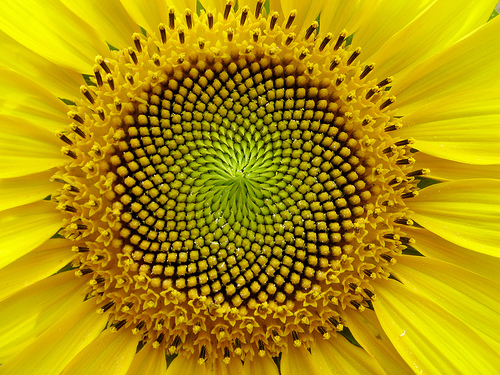
In one week my next Poetry from Art course (for adults) will start at Tate Modern, with two sessions in the wonderful Gabriel Orozco (see a previous post), then one in Ai Weiwei's Sunflower Seeds. Poems from the course will be published on the Tate Modern website in April. The art and English teachers of Lingfield school also hope to eventually publish a book of poems and drawings from the schoolkids' visit to the Tate and I'm looking forward to getting my copy. Meanwhile, here are some images of the sunflower seeds, fake and real, and a sunflower with the seeds packed in golden Fibonacci spirals.


Sunday, 30 January 2011

My TS Eliot Prize Reading in the Royal Festival Hall

Here is a recording of my entire reading at the 2010 TS Eliot Prize Readings in the Royal Festival Hall on 23rd January. This time last Sunday, I was nervously making my way to the Southbank and what turned out to be a two-thousand plus audience. Ian McMillan of Radio 3's The Verb introduced us all generously and warmly, welcoming us to that scary stage. I loved his joke about each poet speaking for only eight minutes, but not eight 'poetry' minutes.  


The poems I read from my shortlisted collection What the Water Gave Me: Poems after Frida Kahlo were 'Remembrance of an Open Wound', 'What the Water Gave Me (V)', 'The Little Deer' and 'What the Water Gave Me (VI)'

The Poetry Book Society has recorded all ten of the shortlisted poets' readings and you can listen to them all on one page here.
I'm looking forward to hearing them again, including Nobel laureate Seamus Heaney, and
Nobel laureate Derek Walcott, the winner of this year's prize, whose poems were read by Daljit Nagra.

There are three more of my poems from What the Water Gave Me, and by each poet from their shortlisted collections, on the Guardian website.

Monday, 10 January 2011

Poetry from Art at Tate Modern: Gabriel Orozco


Gabriel Orozco made 'Black Kites' when he was laid up at home with a collapsed lung. He painstakingly drew this black and white graphite grid on a real skull, and has commented on how intense it was for him to live with the skull over a long period. Orozco is a Mexican artist, so I immediately think of the Aztec Tezcatlipoca smoking mirror mosaic skull inlaid with turquoise and jet in the British Museum, and the lifesize rock crystal skull carved from quartz crystal, reputed to be Aztec, though this is disputed.

Elevator

Orozco is a playful, wide-ranging and inventive artist, with photographs, paintings, sculptures, and installations often featuring natural and found objects. A major retrospective of his work will open at Tate Modern next Wednesday, 19 January. I'm looking forward to my next Poetry from Art course which starts on 28 February and hope to spend one or two sessions in this exhibition. The course will culminate in publication of the participants' poems on the Tate Modern website. This course is booked out, but there are still a few places for the summer term, when the Miro exhibition will be on.


Dial Tone


Friday, 31 December 2010

The creatures in our garden in 2010


We live in a two-up two-down terraced house in East London and have a very small overgrown garden, but over the past year it has been inhabited by a menagerie of creatures, including in July a swarm of bees which nested temporarily in our jasmine laden buddleia. Foxes shelter in our collapsed shed and toads hide from our four cats under the understorey of
campanula and ivy. Photos all taken by Brian. Happy 2011 to you all from us and the beasts who share our lives.