Thursday, 8 September 2011

Hand-feeding the Notre Dame sparrows

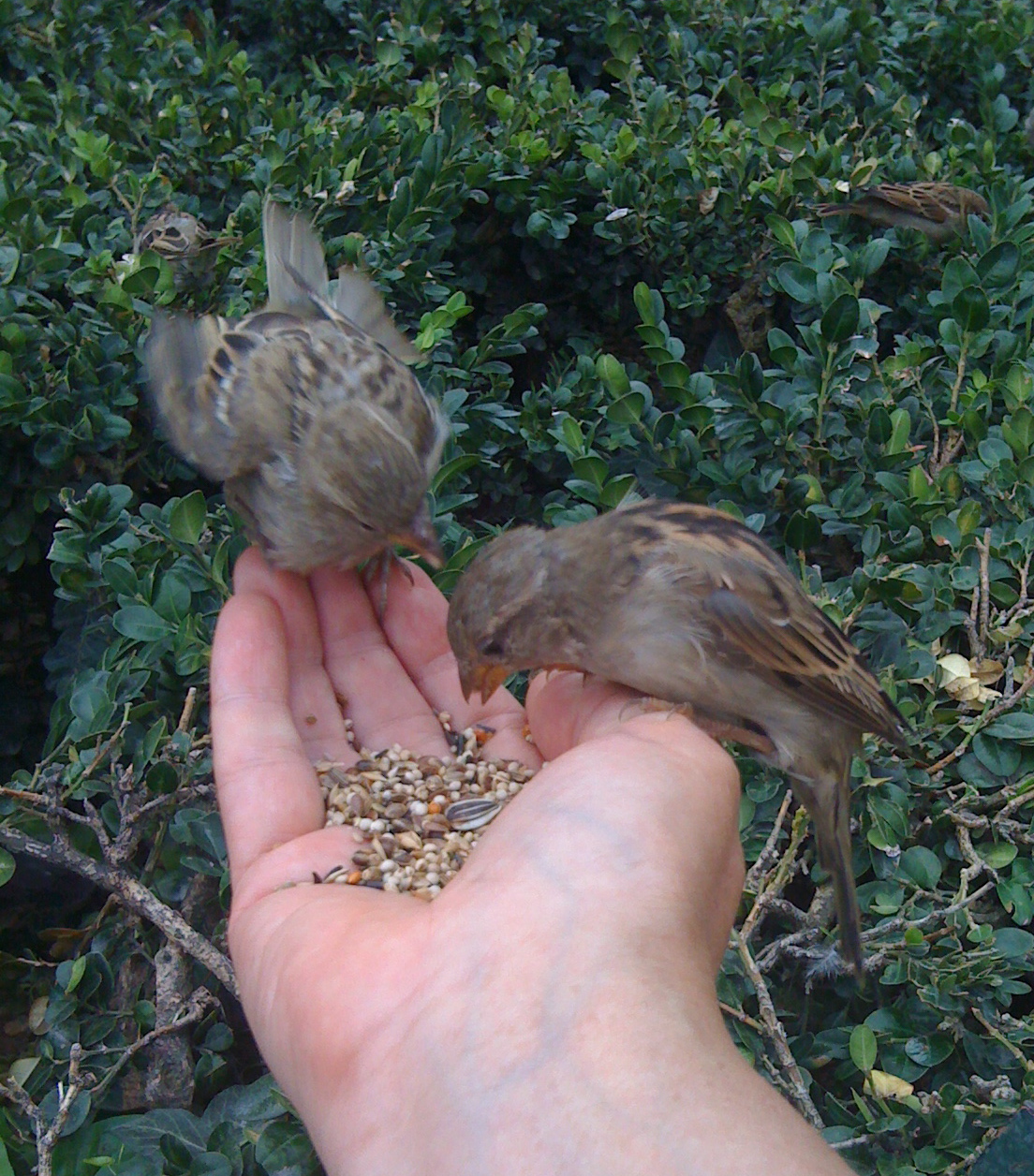
Every time I stay in Paris there are new surprises. One of the highlights of last week's visit was hand-feeding the sparrows in front of Notre Dame. The box hedges on the parvis are bustling with them, mostly juveniles – their breasts and wings still downy. Every day I was drawn back. The first day I just watched as two regulars hand-fed them and a few tourists joined in.  The second day one of the men gave me a handful of birdseed and I stood up on the low concrete wall around the privet and held out my hand. I waited, and quite soon a young female sparrow hopped onto my fingers. Her claws grasped me and she bent down and picked up a seed with her yellow and fawn beak. It took her quite a while to crack and eat it and I managed to glimpse her peach tongue. She stayed on my hand for half an hour, batting off all intruders by raising her wings and fiercely beating them, cheeping at the same time.

The second day
I had up to three sparrows feeding together, some fully grown males as well as females and juveniles. The males have darker colouring around their heads, black and brown markings. By this time I'd been to the Marché aux Oiseaux and bought some small wild-bird grains. On the third day (I would pass there on my evening walk after a day's writing) I had six sparrows feeding together, males and females. At one point pigeons landed and starlings. That day I fed the moineaux for an hour and a half, as I was leaving the next morning, to return to London where sparrows are scarce. These pictures were taken on my iPhone with my free hand, though the last six-sparrow day I didn't take any as I wanted to just concentrate on the experience. It was the same with Notre Dame, every time I looked at the cathedral, especially the facade and towers, I saw more. I looked and looked harder.


 The young female who stayed on my hand for half an hour the first day


 Here you can see the beginning of the sending-off display, as one bird starts to raise her wings to beat them at the other.


The man with the black hat is one of the two regulars. They come every day, all day. The other one told me he comes because it makes him feel better when things aren't going well.

Tuesday, 23 August 2011

The Languedoc, August 2011

I have been visiting the Languedoc Rousillion since I was a child, when my mother bought a steep terraced vineyard near Lodève, with two shepherds' stone huts and a deep banked stream in the sous-bois. We used to camp in the stone huts, after the fire brigade had smoked out the hornets' nests. There are no vines left now but those childhood summers have drawn me back again and again to this wild land with its limestone moors and gorges.

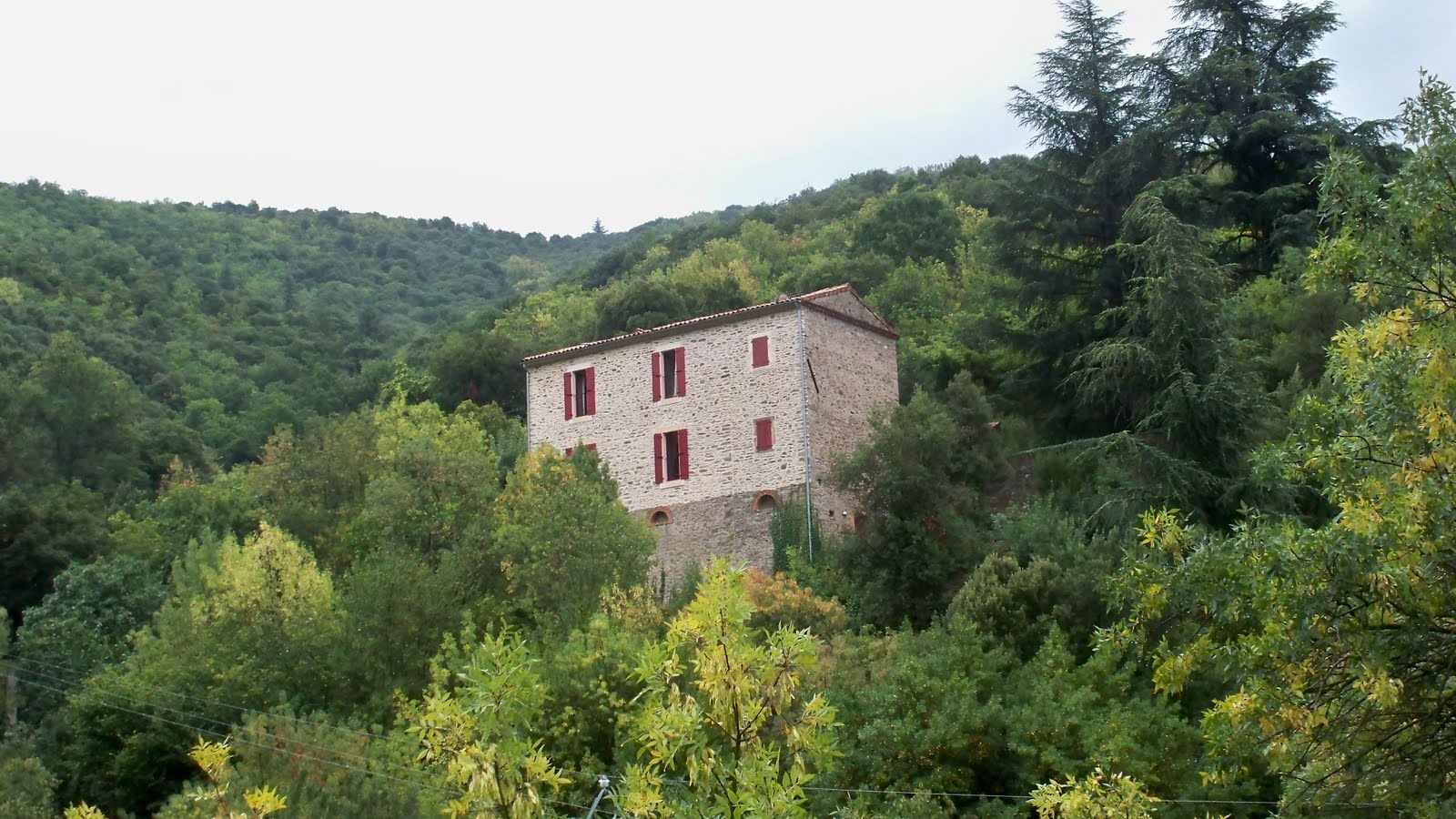
This August, B and I rented a house up the remotest hill of the Orb Valley for one week. The evening we arrived the snowy tree crickets' chirrs filled the house from every window, a sound much like moonlight if it had a voice, more otherworldly than the daytime cicadas, another sound I love. Ours was the last house of the hamlet of Le Lau and the surrounding woods are wild boar hunting grounds. One morning I heard the dogs and hunters capturing a boar; its shrieks gave me a migraine. At night I heard genets, which sound like a cross betweeen a
cat and a fox. I saw one darting across the car park when we visited the Gorge de l'Hèric, spotted and with a long bushy tail. On our last night, we heard a boar snuffling and grunting just a few feet away from us as we sat on the unfenced terrace. It was enthralling to be so close but after standing closer to peer at him (he could have charged!) we decided to retreat to safety.

To get to the Gorge du Tarn, Gorge de la Jonte (and its vultures) and the Chaos of Montpellier le Vieux, B had to drive up the Pas de l'Escalette. This is a spectacular pass from the Languedocien plain to the Causses (limestone moors) of the most southerly Massif Central range. The A75 autoroute recently replaced the old A9 road, which we both remember, and that, in its time, replaced an iron ladder for passengers to disembark from their carriages, climb up the cliff, then continue in another carriage. Now, there is a series of tunnels that cuts through then winds round the Steps of the Ladder.  It's only this time that I realised just how much this landscape paved the way for my obsession with Venezuela's Lost World, with its cliff-bordered sky-islands. The causses and gorges were the prototype, so that when I journeyed to the Lost World I recognised it as home, though it plainly wasn't, and is actually hostile in its remoteness and grandeur.
View from the lane above Le Lau across the Orb Valley, early morning


View from Chaos of Montpellier le Vieux

Village of Trèves on the road to Gorge du Tarn

Gorge du Tarn

The medieval and higgledy hamlet of Le Lau from the kitchen door

The sudden storm from the living-room window, thunder echoed around the hills and the wind was wild!

The house from the lane to Le Lau

Chaos of Montpellier le Vieux on the Causse Noir

Chaos of Montpellier le Vieux is just like the tops of Venezuela's plateaus, with eroded rock shapes, though these are limestone and those are quartzite sandstone.

A typical panorama

Vineyards in the Orb Valley, on our way to the Forest of War Veteran Writers

Pas de l'Escalette

Pas de l'Escalette tunnels, no photo does this pass justice. It emerges onto the Larzac Causse, which leads to the Millau viaduct which is 750 metres high and leads to the upper gorges of the Tarn and Jonte.

Sunday, 24 July 2011

Research trip to Paris then Languedoc


This Irish pub Finnegans Wake is at 9 rue des Boulangers, about 3 minutes' walk from the Jardin des Plantes, in Paris's Quartier Latin. I have often walked past it down the steep, narrow, cobbled old street, when I used to visit my father and on my way to the Jardin, and chuckled at the pub's name. Later, my father told me that the first place he lived with my mother was in a two-room tiny apartment above it, and that they were happy there. By one of those strange coincidences, I came across a cheap studio room available for holiday rentals directly opposite where they used to live, in 10-12, on the opposite side of the narrow street, also on the first floor. So I've rented it and will stay there one week on 7th August, to research for my novel and sixth collection. 

This is only possible because the Society of Authors awarded me an Authors' Foundation grant. During a hectic teaching week since I heard the news, I have been making plans and bookings. After Paris, I will spend a week in a remote house at the top of a tiny hamlet in the Parc Naturel Régional du Haut-Languedoc, where I hope to do some more writing as well as exploring.

Wednesday, 6 July 2011

A Poem for Frida Kahlo's Birthday: Diego on My Mind


Frida Kahlo was born on 6th July 1907 and died in 1954 at the age of 47. Here is a poem from What the Water Gave Me: Poems after Frida Kahlo to celebrate her birthday. She often painted herself with a portrait of Diego on her forehead, as in this painting Diego on My MindHere, she is speaking to him and perhaps to herself as she used to feel very alone when he was out with his celebrity mistresses.

Diego on My Mind

Today I chose the ceremonial huipil
with a lace cobweb framing my face.

I have made a fine bed for you
with the white frills of my Tehuana headdress.

And on the counterpane of my brow
           just where the pillows would rest
I have painted your portrait.

All day you keep me company
as I work each gauze bud
into a stiff flower.

You whisper encouragements from the mirror,
nestling deeper into my forehead.

But remember, when you take
          María Félix
                    Paulette Goddard
                              or my sister

to your dirty yellow hotel room,
they lie on my eyes.

My nose smells them.
My mouth stays closed. Every love-cry

is a silk tendril
          quivering in my silent house.


Tomorrow I'm going to Cardiff to the Wales Book of the Year ceremony, particularly thrilled to have What the Water Gave Me shortlisted for this Welsh prize as I grew up there so it feels like my adopted country has adopted me. The UK edition is available from the Welsh publisher Seren and the US edition (just published) from Black Lawrence Press. I'll be giving an illustrated reading from the book at Pallant House gallery in Chichester, 6pm on Thursday 28 July, during their Frida Kahlo and Diego Rivera exhibition which opens 9th July. Can't wait to see it!


Tuesday, 5 July 2011

Touching sculptures at Tate Modern for Poetry from Art

For our penultimate session of Poetry from Art at Tate Modern the curator of the Tate access project Marcus Dickey Horley gave us a Touch Tour in the States of Flux galleries. Usually, no sighting person is allowed to touch the sculptures, as Marcus provides the tour for blind and visually impaired visitors, but he requested special dispensation for us. Only the sturdiest sculptures can be touched and then it's through lint-free gloves, but imagine if you could feel Rodin's The Kiss. We also felt Umberto Boccioni's futuristic machine-man Unique Forms of Continuity in Space and Raymond Duchamp-Villon's animal-machine hybrid Large Horse.

After the Touch Tour and Marcus' fascinating insights into the sculptures, we read the adulterous kissers Francesca and Paolo's tragic story from Dante's Inferno (in Ciaran Carson's translation – half terza rima, half ballad). Their lips never quite meet in the Inferno and they are destined to stay frozen apart but tantalizingly close throughout eternity in the second circle of hell, after Francesca's husband murdered them as they were about to embrace. In the marble they do seem to have just about started, though you have to crane your neck in to see their lips. The sculpture was daringly frank for its day (1904), a curious blend of classicism and eroticism. We also read 'The Race' by Sharon Olds as a study of a poem about speed, for those who wanted to write from Boccioni's striding figure or the leaping war horse.

You can read poems from this session and the rest of the term, in the Miró exhibition, the Rothko room, and Lamia Joreige's Objects of War, in the pamphlet anthology Poetry from Art at Tate Modern 2011, to be launched at 6.45pm on Saturday 24 September, in the East Room at Tate Modern. Entry will be free, and there'll be readings, wine and great views. Please join us if you're in town.


 The Kiss Auguste Rodin, 1901-4 Pentelican marble

Sunday, 3 July 2011

My trip to New Mexico, 1-7 May 2011

It was snowing when I arrived in Albuquerque airport on May 1st, and by the time the shuttle arrived to take me to Santa Fe, where I was met by the poets Veronica Golos and Andrea Watson, a blizzard obscured the longed-for views on the winding road to Taos in the mountains. When Veronica took me for a hike in the Rio Grande Gorge, snowdrifts still flanked our path. But within a few days the weather switched to dry desert heat. Here are some pics taken in Taos, at the Taos Pueblo, and in the Rio Grande Gorge. Warm thanks to the fabulous poet Veronica Golos for inviting me into her home, to her and Andrea for their hard work organising a reading and workshop, and to Arthur Sze for a super meal in Santa Fe on my way back to Albuquerque and on to the next leg of my tour, California.

Also at the end you'll see a strange dried creature in a small Taos museum. It's a baby shark
used by the Mexican Cora tribe as a charm against evil spirits. It was caught on a moonlit night during the primal equinox at the precise moment that a cloud passed over the moon. The method by which it was dried did not include any metal instruments and is a closely guarded secret. 


Sunday, 26 June 2011

What the Water Gave Me now published in US by Black Lawrence Press

For anyone in the US who'd like to buy my collection What the Water Gave Me: Poems after Frida Kahlo, I'm delighted to announce that it's now published by Black Lawrence Press and available to buy from their website for $14.


What the Water Gave Me was first published by Seren in 2010. It was shortlisted for the TS Eliot Prize, Wales Book of the Year and was a Book of the Year in the Observer. There's more information about it and sample poems on my website.